Residential Electrical Services in Lawrenceville, GA
Gable, roof-mount and solar attic fans installed with proper wiring and thermostat controls to keep your home comfortable and your energy bills down.
A Georgia attic in July can get well past 130°F, and that heat doesn't stay put — it soaks right down into the rooms below. A properly wired attic fan, on the right circuit with the right controls, moves that heat out before it becomes your problem.
Overview
Before we install anything, we check one thing most people never think to ask about: does your attic actually have enough intake venting to replace the air a fan pulls out? If the soffits are blocked or undersized, a powerful fan will just pull conditioned air out of your living space instead — through recessed lights, the attic hatch, wherever it can find a path. We check that first, size the fan properly, and put it on a thermostat so it only runs when it's actually helping.
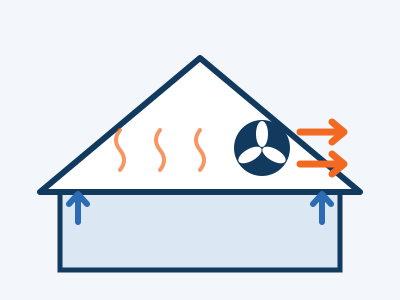
A powered fan has to pull replacement air from somewhere. If the soffit vents are blocked or undersized, it pulls from the easiest path — recessed light cans, the attic hatch and bath fan ducts — which drags cooled air out of the house and can even backdraft gas appliances. We look at the soffit and ridge venting first and tell you plainly if a fan is the wrong fix.

In a Lawrenceville summer, an unventilated attic can reach 150°F. That heat radiates through the ceiling into your living space, forcing your AC to work harder and run longer. An attic fan — either a gable-mounted exhaust fan or a roof-mounted unit — pulls that superheated air out and replaces it with cooler outside air. The temperature drop is dramatic: 30–50 degrees in the attic, which translates to lower AC runtime and real savings on your Georgia Power bill. A thermostat-controlled fan runs only when the attic hits a set temperature (typically 100–110°F), so it's not wasting energy on mild days.
We wire attic fans on a dedicated circuit with an adjustable thermostat so you can set the activation temperature. Solar-powered attic fans don't need a circuit at all — they run on a small panel mounted next to the fan and only operate when the sun is strong enough to drive the motor, which is conveniently when the attic is hottest. For standard electric fans, we run the circuit from the panel through the attic to the fan location, mount the thermostat where it reads attic air temperature accurately (away from direct sunlight through the roof deck), and test the whole system before we leave.
We provide attic fan installation across Lawrenceville and nearby communities including Suwanee, Duluth, Snellville, Grayson, Dacula, Lilburn and Buford, plus much of metro Atlanta — Buckhead, Brookhaven, Sandy Springs, Chamblee, Midtown, Druid Hills and more. Our electricians are Georgia-licensed, insured, and familiar with local permit and inspection requirements.
Most attic fan calls are either a new install over a hot upstairs or a fan that has stopped running; we handle both.
Who We Serve
Homes and businesses across Lawrenceville, Gwinnett County and metro Atlanta.
Gable, roof-mount and solar attic fans installed with proper wiring and thermostat controls to keep your home comfortable and your energy bills down.
Warehouse, office and shop attic ventilation systems wired and controlled to protect inventory and lower HVAC costs.
Why Us
The team Lawrenceville trusts for attic ventilation done to code.
Every repair and installation carries a written workmanship warranty, plus manufacturer warranties on the parts we supply.
Georgia-licensed electrical contractor, fully insured, and every technician is background-checked and uniformed.
Shoe covers, drop cloths, and we haul away the old material. We explain what we did and why before we leave.
You approve a clear price before any work begins, with same-day appointments and true 24/7 emergency response.
Service Area
Based at 241 Lawrenceville Hwy, we serve Lawrenceville, Gwinnett County and communities across metro Atlanta. Full list in the footer below.
Licensed electricians for every job in your home or business — pick a service to see how we handle it.
FAQ
It can make upstairs rooms more comfortable and reduce the heat soaking into the ceiling, but results depend heavily on insulation and venting. In a well-insulated, air-sealed attic the gain is smaller. We will tell you honestly which situation you are in.
The most common causes are a failed thermostat (the fan doesn’t know the attic is hot), a burned-out motor (common in fans over 10–15 years old), a tripped breaker or GFCI on the circuit, or a blown capacitor in the motor. We diagnose the specific failure and replace the failed component. If the motor is burned out on an older fan, replacing the entire unit is usually more cost-effective than just the motor.
Solar attic fans are a good option if you want to avoid running a new electrical circuit. They mount on the roof with an integrated solar panel and operate only when the sun generates enough power to drive the motor — which is conveniently when the attic is hottest. The trade-off is lower CFM (airflow) compared to a hardwired electric fan, and no operation on cloudy days or at night. For moderate-sized attics, a solar fan is often sufficient.
No. An attic fan exhausts hot air from the attic space to reduce heat transfer through the ceiling into your living area. It runs automatically via a thermostat and you don’t feel it operating. A whole-house fan is mounted in the ceiling of your living space and pulls air from inside the house up through the attic and out the vents — it’s a substitute for air conditioning on mild evenings. Different products, different purposes, different installation.
Cool your attic, protect your roof and cut cooling costs with a properly wired attic fan.