
Residential Electrical Services in Lawrenceville, GA
Fan-rated boxes, downrod sizing for high ceilings, remote-capable wiring and outdoor-rated patio fans installed safely on the first visit.
Wobbly fan? No fan at all where you really want one? Most of what makes a ceiling fan installation go wrong has nothing to do with the fan itself — it's the box behind it. We check that first, every time.
Overview
Here's something most people don't think about: a ceiling fan is heavier and puts more stress on a ceiling box than a regular light fixture ever will. If that box isn't fan-rated and properly braced, you'll get wobble and noise no matter how well the fan itself is balanced. We start there, then handle the wiring, the switching, and the fan itself so it runs quiet from day one.
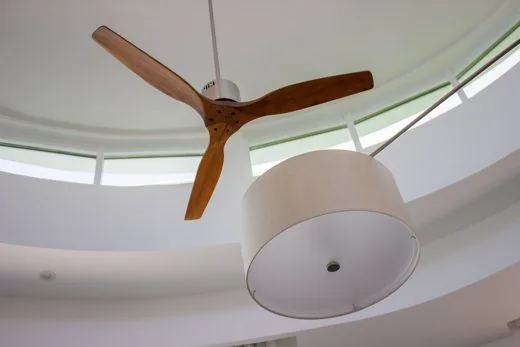
A standard lighting box is rated for a static fixture weight, not the dynamic load of spinning blades. Fan-rated boxes are labeled and are secured to the framing or to a listed brace bar between joists. If your ceiling has a plain box, we replace it — this is the single most important part of a safe fan install.

If you want independent control of the fan and the light from the wall, the box usually needs a second switch leg. We'll tell you before we start whether your existing wiring supports that or whether we need to pull an extra conductor, and we can also set you up with a smart fan control.
Blade span should match the room (roughly 44–52 inches for a typical bedroom, larger for great rooms), blades should sit 8–10 feet off the floor and at least 18–24 inches from any wall, and on high ceilings a longer downrod brings the fan into the zone where it actually moves air on you.
A ceiling fan weighs 25–50 pounds and vibrates constantly. A standard light fixture box isn't rated for that weight or that movement — it's held by a single nail into a joist and will eventually pull loose. A fan-rated box is braced between two joists (or anchored with a metal bracket that expands to fit) and rated for 70 pounds. We check and upgrade the box before we hang the fan, every time. If the box looks fine but isn't fan-rated, we replace it anyway, because looking fine and being safe aren't the same thing.
A fan that's too small moves air you can't feel. A fan that's too large overwhelms a small room and looks wrong. The sizing rule is straightforward: 42-inch fans for rooms up to 144 square feet, 52-inch for rooms up to 225 square feet, and 60-inch or larger for great rooms and open-plan spaces. Ceiling height matters too — in rooms under 8 feet, a flush-mount (hugger) fan keeps the blades at a safe height; in rooms over 9 feet, a downrod brings the fan low enough to move air where people actually sit. We'll measure and recommend the right combination before you buy.
We provide ceiling fan installation across Lawrenceville and nearby communities including Suwanee, Duluth, Snellville, Grayson, Dacula, Lilburn and Buford, plus much of metro Atlanta — Buckhead, Brookhaven, Sandy Springs, Chamblee, Midtown, Druid Hills and more. Our electricians are Georgia-licensed, insured, and familiar with local permit and inspection requirements.
Most fan problems trace back to the box or the switching, not the fan, so we check both before we hang anything.
Who We Serve
Homes and businesses across Lawrenceville, Gwinnett County and metro Atlanta.
Fan-rated boxes, downrod sizing for high ceilings, remote-capable wiring and outdoor-rated patio fans installed safely on the first visit.
Lobby, dining and office ceiling fans installed for air circulation and tenant comfort, wired to dedicated switches or smart controls.
Why Us
A ceiling fan problem is usually the box, not the fan — we fix both.
Every repair and installation carries a written workmanship warranty, plus manufacturer warranties on the parts we supply.
Georgia-licensed electrical contractor, fully insured, and every technician is background-checked and uniformed.
Shoe covers, drop cloths, and we haul away the old material. We explain what we did and why before we leave.
You approve a clear price before any work begins, with same-day appointments and true 24/7 emergency response.
Service Area
Based at 241 Lawrenceville Hwy, we serve Lawrenceville, Gwinnett County and communities across metro Atlanta. Full list in the footer below.
Licensed electricians for every job in your home or business — pick a service to see how we handle it.
FAQ
Yes. We run a new circuit from the panel or an existing junction box to the ceiling location, install a fan-rated box braced between the joists, and mount the fan. If attic access is available above the room, the installation is straightforward. Without attic access, we use remodel fan boxes that install from below. In either case, you also get a wall switch or remote to control the fan and light independently.
A wobbling fan is usually caused by unbalanced blades (from dust buildup or a warped blade), a loose blade screw, or — more seriously — a junction box that isn’t fan-rated and is slowly pulling free of the joist. The last scenario is dangerous because the fan can fall. We check the box first. If it’s fan-rated and secure, the fix is typically a blade rebalancing or a screw tightening. If the box is wrong, we replace it.
Only if it’s rated for damp locations. A covered porch protects the fan from direct rain but not from humidity, temperature swings and airborne moisture. Damp-rated fans have sealed motors and corrosion-resistant finishes designed for these conditions. A standard indoor fan will corrode and fail prematurely. For an uncovered porch or pergola, you need a wet-rated fan, built to handle direct water exposure.
We install ceiling fans at any height. For standard 8-foot ceilings, a flush-mount (hugger) fan keeps the blades at a safe height. For ceilings above 9 feet, a downrod brings the fan low enough to move air effectively — the ideal blade height is 8–9 feet above the floor. For vaulted, cathedral or two-storey ceilings, we use extended downrods and angled mounting adapters. We measure and recommend the right setup.
Get it hung right the first time — fan-rated box, balanced blades and a clean finish.