Residential Electrical Services in Lawrenceville, GA
Ground rod upgrades, grounding electrode systems, water and gas pipe bonding, and two-prong to grounded outlet conversions for older Lawrenceville homes.
Two-prong outlets? Surge protector's "protected" light never comes on? Both point to the same thing — grounding that isn't doing its job. We test it, tell you honestly what's missing, and bring it up to code.
Overview
Grounding is the part of your electrical system you never see and rarely think about, right up until something goes wrong and it matters more than anything else in the panel. It gives fault current a safe path home so the breaker trips instead of you. A lot of older Lawrenceville homes still have two-prong outlets with no ground at all, or a ground rod that's corroded past the point of doing its job — and almost none of it is visible from the outside.
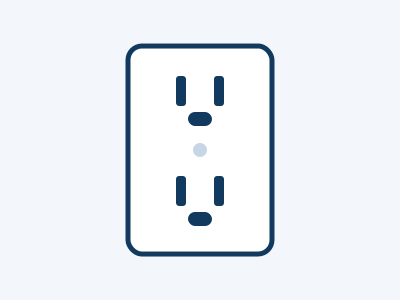
Two-prong outlets, three-prong outlets that a tester shows as “open ground,” a tingle from an appliance or faucet, surge protectors whose “protected” light never comes on, and a panel with no visible ground wire all point to a grounding problem. So does an older home whose only ground was a clamp on a metal water pipe that has since been replaced with plastic.
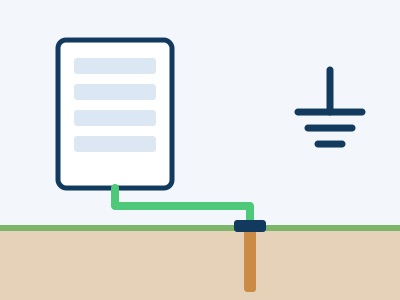
Grounding gives fault current a low-resistance path back to the panel so the breaker can trip and clear the fault. Without it, a short inside an appliance energises the metal case, and the next person who touches it becomes the path to ground. A properly grounded system clears that fault in milliseconds — the breaker trips before anyone gets hurt. We see homes in Lawrenceville with missing ground wires, disconnected ground rods, and bonding jumpers that were removed during plumbing work. Each one is a silent gap in the safety system that only shows up when something goes wrong.
Current code requires two grounding electrodes — typically a pair of 8-foot ground rods driven at least six feet apart, or one ground rod supplemented by a concrete-encased electrode (Ufer ground) if the foundation has rebar. Older homes often have a single ground rod or relied on the metal water pipe as the sole electrode. If the utility has replaced the street-to-meter water pipe with plastic (which Georgia utilities have been doing for years), that ground path is broken and your panel is effectively ungrounded. We test the electrode system's resistance and add or replace rods to bring it to code.
A ground rod that's been in Georgia red clay for 30 years corrodes. We test the electrode's resistance to earth with a fall-of-potential meter — the NEC calls for 25 ohms or less, and we aim for under 10. If the reading is high, we drive a supplemental ground rod at least six feet from the first and bond them together. In rocky or dry soil, a chemical ground rod or a ground enhancement compound can lower resistance where a second rod alone won't. We include a grounding test as part of every panel upgrade and every inspection, and we'll add it to a standalone service call if you've never had your grounding verified.
We provide electrical grounding and bonding across Lawrenceville and nearby communities including Suwanee, Duluth, Snellville, Grayson, Dacula, Lilburn and Buford, plus much of metro Atlanta — Buckhead, Brookhaven, Sandy Springs, Chamblee, Midtown, Druid Hills and more. Our electricians are Georgia-licensed, insured, and familiar with local permit and inspection requirements.
Grounding is usually a handful of small corrections rather than one big job, and we price each one separately.
Who We Serve
Homes and businesses across Lawrenceville, Gwinnett County and metro Atlanta.
Ground rod upgrades, grounding electrode systems, water and gas pipe bonding, and two-prong to grounded outlet conversions for older Lawrenceville homes.
Equipment grounding, ground-fault paths and bonding for commercial buildings, data rooms and sensitive equipment.
Why Us
Grounding protects people and equipment — we make sure it actually works.
Every repair and installation carries a written workmanship warranty, plus manufacturer warranties on the parts we supply.
Georgia-licensed electrical contractor, fully insured, and every technician is background-checked and uniformed.
Shoe covers, drop cloths, and we haul away the old material. We explain what we did and why before we leave.
You approve a clear price before any work begins, with same-day appointments and true 24/7 emergency response.
Service Area
Based at 241 Lawrenceville Hwy, we serve Lawrenceville, Gwinnett County and communities across metro Atlanta. Full list in the footer below.
Licensed electricians for every job in your home or business — pick a service to see how we handle it.
FAQ
Not without a ground. A three-prong outlet on an ungrounded circuit looks safe but is not. Code allows a GFCI outlet labelled 'No equipment ground' as a fix in many cases, or we can run a grounded circuit. We will explain which fits your home.
The simplest check is to look at your outlets. If they have three prongs, the house was wired with ground conductors (though that doesn’t confirm the ground is intact). If you see two-prong outlets, the branch circuits in that part of the house have no ground wire. A proper test requires checking the panel’s grounding electrode connection and measuring the ground rod’s resistance to earth, which we do with a fall-of-potential meter.
Absolutely. A surge protector diverts excess voltage to the grounding system. If the ground path has high resistance (a corroded rod, a broken bond, a missing electrode), the surge has nowhere to go efficiently, and the protector can’t do its job. We test the grounding system’s resistance as part of every whole-house surge protector installation to make sure the ground path is solid before we connect the SPD.
No, and the distinction matters. Grounding provides a path for fault current to flow from the panel to the earth electrode, so the breaker can trip and clear the fault. Bonding connects all metal components (pipes, ducts, equipment enclosures, rebar) so there are no voltage differences between them that could shock someone touching two metal surfaces simultaneously. A safe electrical system needs both, and they serve different purposes.
Properly grounded circuits protect your family, your electronics and your insurance standing.